Online reading edition
The complete Version 1.2 text.
The wording follows the 46-page scholarly PDF. Web formatting, responsive tables, and section links improve reading and discovery without changing the canonical definitions.
Abstract
Unified Living Computation Science (ULCS) is proposed as an author-defined taxonomic framework for organizing computation as it manifests in living, semi-living, synthetic, and hybrid biological systems. Although these subjects are studied across biology, physics, computer science, systems science, and engineering, the author is not aware of a broadly adopted taxonomy that coordinates them under a single framework focused on computation in living matter under physical constraint. ULCS addresses this proposed organizational gap by defining eight coordinated canonical categories that distinguish intrinsic biological computation, biological code as executable information, hybrid biological–synthetic architectures, carefully delimited quantum-adjacent neural inquiry, material computational substrates, and the physical constraints on emergence and evolution.
ULCS does not replace existing scientific disciplines and does not assert experimental, clinical, technological, or jurisdictional authority. Its function is classificatory and structural. This publication establishes the Foundational Canonical Taxonomy, including governance principles, hierarchical relationships, and explicit non-replacement boundaries. The framework is intended to provide long-term taxonomic coherence for convergent research at the intersection of computation, biology, physics, and engineered life systems.
Keywords: Unified Living Computation Science (ULCS); biological computation; living systems; biohybrid computation; biological information processing; computational taxonomy
2
1. Executive Summary
Unified Living Computation Science (ULCS) is proposed as a scientific megadiscipline dedicated to the systematic classification and organization of computation as it occurs in living, semi-living, synthetic, and hybrid systems.
For purposes of this proposal, physics is treated as organizing inquiry into matter, energy, and physical law; chemistry into molecular interaction and transformation; biology into living systems; and computer science into formal and engineered computation. ULCS does not present this four-part scheme as an official classification of science; it uses the scheme as a heuristic for explaining the proposed organizational gap.
ULCS addresses this structural gap.
ULCS does not replace existing sciences. It provides a meta-level classification framework that:
- Organizes intrinsic biological computation
- Formalizes biological code as executable information
- Classifies hybrid biological–synthetic systems
- Distinguishes exploratory quantum-biological inquiry
- Grounds emergent computation in physical law
This framework classifies those manifestations without asserting that all biological activity is computational or that ULCS replaces established scientific disciplines.
3
2. Framework Overview
ULCS begins from the premise that computation may be analyzed as an organizing process expressed through living matter, biological information, and hybrid biological-synthetic systems.
3
3. Document Status
This document presents the author-maintained Foundational Canonical Taxonomy of Unified Living Computation Science (ULCS), Version 1.2. It is a scholarly proposal and classification framework for academic discussion and interdisciplinary research. It has not been adopted as an official scientific discipline, standard, or institutional classification.
3
4. Purpose of the ULCS Framework
The purpose of Unified Living Computation Science (ULCS) is to provide a coherent taxonomic framework for organizing research at the intersection of biology, computation, and engineered life systems.
Across multiple scientific disciplines, living systems are studied as information-processing entities operating under physical constraint. Systems biology, biological control, synthetic circuits, and living-cell computation provide concrete examples of encoding, sensing, regulation, memory, and state transformation in biological substrates (Kitano, 2002; Helikar et al., 2008; Gao et al., 2018; Rizik et al., 2022).
However, these insights remain distributed across many disciplines, often without a shared classification structure.
ULCS is proposed as a structural framework designed to organize these relationships. The framework does not replace existing disciplines. Instead, it provides a conceptual taxonomy that clarifies how different domains studying biological computation relate to one another.
The intent of ULCS is therefore organizational and integrative rather than prescriptive. Its goal is to provide longterm conceptual coherence as scientific understanding of living computational systems continues to expand.
4
5. Formal Definition of ULCS
Unified Living Computation Science (ULCS) is a proposed scientific megadiscipline dedicated to the systematic classification and structural organization of computational phenomena observed in living, semi-living, hybrid biological–synthetic, and life-adjacent physical systems.
ULCS operates as a meta-level taxonomic framework that coordinates and contextualizes computational processes across multiple scientific domains, particularly where living systems exhibit executable information, intrinsic processing, or emergent computational behavior under physical constraint.
The purpose of ULCS is classificatory rather than jurisdictional. It defines canonical structural domains for organizing research but does not claim authority over experimental methodology, discovery ownership, engineering practice, medical application, or institutional governance.
4
6. Field Definition
Unified Living Computation Science (ULCS)
An author-proposed scientific megadiscipline concerned with the study, classification, and structural organization of computation as it occurs in living systems, biologically integrated physical systems, and hybrid biological–synthetic architectures operating under physical constraint.
Scope and Boundaries of ULCS
Unified Living Computation Science (ULCS) operates as a classificatory and organizational framework for understanding computation as it appears in living systems, biological information processes, and engineered biological–synthetic systems.
ULCS defines structural domains for conceptual organization and interdisciplinary coordination. It does not prescribe experimental methods, technological implementation strategies, or institutional authority over research programs.
The framework is intended to clarify relationships among existing fields rather than replace them. ULCS therefore complements established disciplines including physics, chemistry, biology, computer science, systems biology, and synthetic biology.
ULCS focuses specifically on the classification and conceptual organization of computation occurring in living, semiliving, hybrid biological–synthetic, and life-adjacent physical systems.
4
7. What ULCS Is Not
Unified Living Computation Science (ULCS) is a classificatory and structural framework. It does not replace existing scientific disciplines, including biology, physics, chemistry, computer science, or engineering. ULCS does not assert authority over experimental methodology, technological development, clinical practice, or institutional governance.
The purpose of ULCS is to provide a structural taxonomy that helps organize computational phenomena occurring within living systems and biologically integrated physical systems. It operates as a meta-level classification framework intended to support interdisciplinary clarity rather than disciplinary replacement.
5
8. Scientific Context and Rationale
For the Proposal of a Fifth Scientific Megadiscipline
8.1. Author-Proposed Organizing Context
For purposes of the ULCS proposal, four broad areas are used as an organizing heuristic:
- Physics — inquiry into matter, energy, and physical law
- Chemistry — inquiry into molecular interaction and transformation
- Biology — inquiry into living systems
- Computer Science — inquiry into formal and engineered computation
These areas developed through distinct historical trajectories and now encompass many subdisciplines; the four-part grouping is an explanatory device for this proposal, not a universally accepted hierarchy.
Physics, chemistry, biology, and computer science each developed from multiple intellectual and institutional traditions. Their histories are complex and are not reducible to a single sequence or pattern of disciplinary emergence.
ULCS draws only an organizational analogy: a new framework may become useful when research questions and vocabularies cross established disciplinary boundaries.
In a similar manner, ULCS is proposed as a classificatory framework intended to provide structural coherence across scientific domains in which computation manifests within living systems and biological substrates.
8.2. Relationship of ULCS to Existing Scientific Disciplines
Unified Living Computation Science (ULCS) does not replace existing scientific disciplines. Instead, ULCS provides a structural framework for organizing and classifying computational phenomena observed in living systems, hybrid biological–synthetic systems, and life-adjacent physical processes.
Research relevant to ULCS already occurs across multiple established fields including biology, neuroscience, physics, computer science, systems science, and bioengineering. ULCS functions as a coordinating taxonomy that helps clarify how these areas intersect when computational processes emerge within living or biologically integrated systems.
The purpose of ULCS is therefore organizational rather than jurisdictional. It offers a classification architecture that may assist researchers, educators, and institutions in describing and coordinating interdisciplinary research occurring at the intersection of life sciences, physical sciences, and computational theory.
Examples of how existing fields relate to ULCS include:
| Existing field | Primary focus | Relationship to ULCS |
|---|---|---|
| Molecular Biology | Genetic and cellular mechanisms | Provides foundational biological substrates where computational processes may occur |
| Neuroscience | Neural systems and cognition | Studies intrinsic biological information processing in nervous systems |
| Systems Biology | Complex biological network modeling | Investigates dynamic computational behavior in biological systems |
| Synthetic Biology | Engineering biological systems | Provides examples of designed biological information-processing systems |
| Quantum Biology | Quantum effects in biological processes | Provides candidate mechanisms and empirical constraints for specified quantum-adjacent hypotheses |
| Computer Science | Computational theory and algorithms | Provides formal frameworks applicable to living computational systems |
| Bioengineering | Engineering biological and hybrid systems | Develops biological-synthetic computational architectures |
This relationship illustrates how ULCS is intended to function as an author-proposed classificatory framework for research occurring across multiple scientific domains, without replacing those domains.
8.3. The Fragmentation of Computation Across Sciences
Computation is currently studied across multiple independent fields:
- Systems biology
- Synthetic biology
- Neural computation
- Artificial intelligence
- Information theory
- Quantum biology
- Complex systems science
- Bioengineering
Computation in living systems is not currently organized under a single broadly adopted scientific category.
Relevant work is distributed across biology, physics, computer science, engineering, and allied fields, each with its own vocabulary and classification practices.
This fragmentation produces:
- Terminological inconsistency
- Cross-scale incompatibility
- Redundant theoretical frameworks
- Difficulty comparing biological and engineered systems
The author is not aware of a broadly adopted megadiscipline dedicated specifically to classifying computation across living, semi-living, and hybrid systems. This is a claim about current organizational practice, not about an absence of relevant research in established fields.
8.4. The Conceptual Gap
Biology studies life.
Computer science studies formal algorithms.
Physics studies matter and energy.
Within the organizing scheme used here, no single broadly adopted framework is dedicated to coordinating all of the following:
- Living systems as computational entities
- Biological code as executable information
- Hybrid biological–synthetic computation
- Organ-level and material-level computational embodiment
- Evolution modeled as a computational process under physical constraints
This gap becomes increasingly visible as:
- Synthetic biology advances
- Neural modeling becomes more computational
- Biohybrid systems expand
- Living materials are engineered
- AI increasingly intersects with biology
The absence of a shared classification framework may hinder comparison, terminology alignment, and coordination across these research areas.
8.5. Rationale for Unified Living Computation Science (ULCS)
Unified Living Computation Science (ULCS) is proposed to fill this structural gap.
ULCS does not replace:
- Physics
- Chemistry
- Biology
- Computer Science
It instead provides a meta-level classification framework that organizes how computation manifests in:
- Living biological systems
- Hybrid biological–synthetic systems
- Engineered organ systems
- Material and substrate-level embodiments
- Evolutionary and emergent physical processes
ULCS uses a broadened but operationally constrained concept of computation that includes physically instantiated information processing and state transformation in living systems; it does not treat every biological process as computational.
Its purpose is structural coordination — not scientific displacement.
8.6. Organizational Analogy: Computer Science
The development of computer science in the 20th century provides an organizational analogy, not a predictive historical precedent.
Computation previously existed inside:
- Mathematics
- Electrical engineering
- Logic
- Physics
Modern computer science developed from mathematics, logic, electrical engineering, physics, and related traditions into a distinct and internally diverse field.
ULCS proposes a coordination framework for computation in living and life-adjacent systems. It does not assume that ULCS will follow the historical path of computer science or achieve institutional recognition.
8.7. Nature of the Proposal
ULCS is:
- Taxonomic
- Classificatory
- Organizational
- Theoretical
ULCS is not:
- A claim of experimental discovery
- A replacement for established sciences
- A medical or technological assertion
- An exclusive jurisdiction over biological research
The proposal is structural in nature.
8.8. Transition to Canonical Taxonomy
The following sections define the Canonical Structure of ULCS, including:
- The Parent Megadiscipline
- The Primary Scientific Domain
- Foundational Subdomains
- Applied and Substrate Domains
- Theoretical Grounding Domains
The hierarchy, naming, and arrangement constitute the formal structure of the proposed megadiscipline.
6–10
9. Cross-Discipline Mapping and Compatibility Framework
Relationship of ULCS to Existing Scientific Disciplines.
Unified Living Computation Science (ULCS) does not replace existing scientific disciplines. It provides a structural classification layer that coordinates and contextualizes computational phenomena across them.
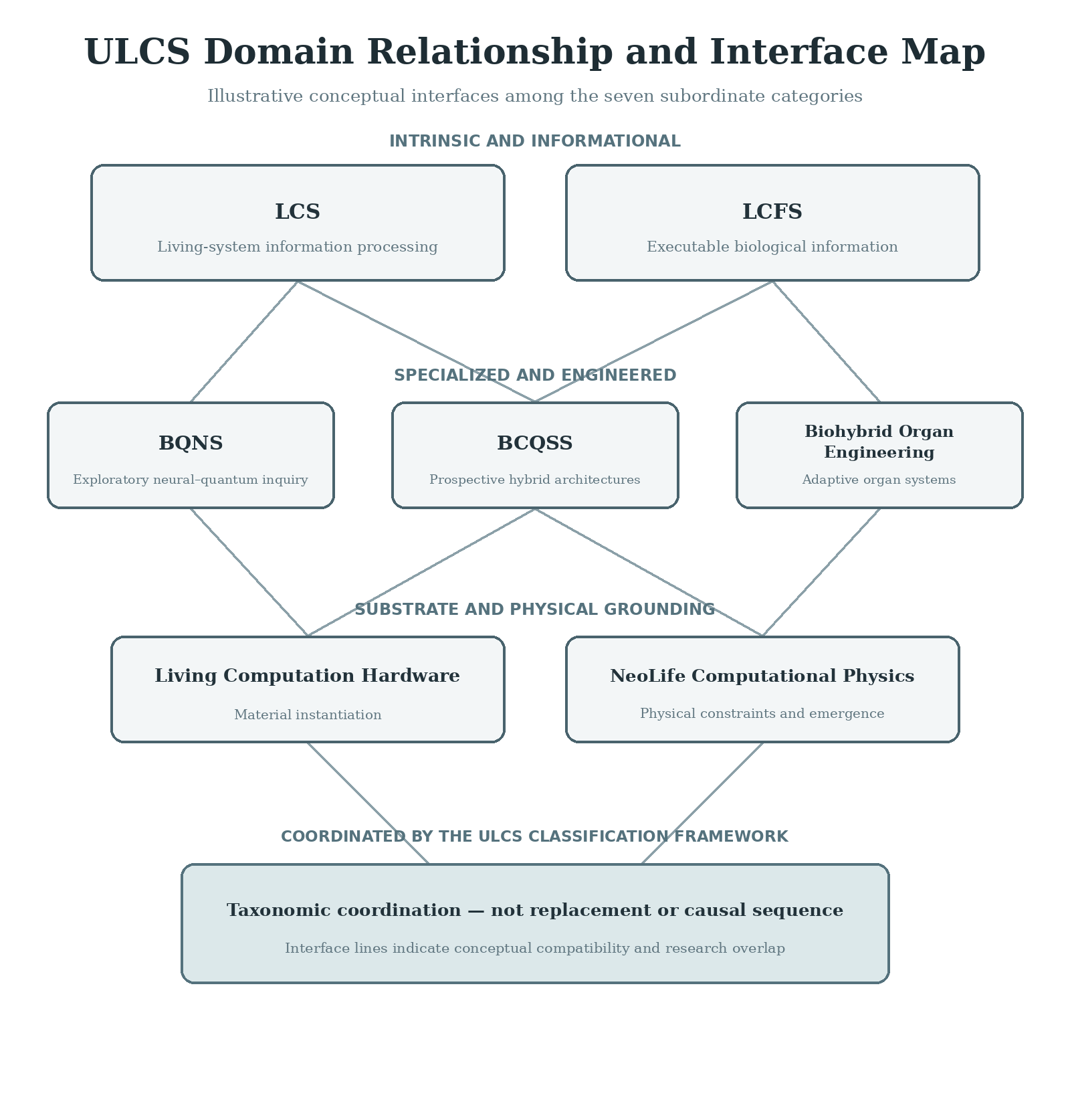
The following table illustrates conceptual compatibility and mapping relationships:
| Established field | Primary focus | ULCS domain mapping | Nature of relationship |
|---|---|---|---|
| Systems Biology | Regulatory networks and cellular dynamics | LCS + LCFS | Intrinsic biological computation |
| Molecular Biology | Genetic and biochemical mechanisms | LCFS | Biological code formalization |
| Neuroscience | Neural signaling and cognition | LCS | Classical intrinsic computation |
| Quantum Biology | Quantum effects in living systems | BQNS | Specialized neural-quantum inquiry |
| Synthetic Biology | Engineered biological systems | LCFS + BCQSS | Code-layer and applied system integration |
| Bioengineering | Hybrid biological-synthetic systems | Biohybrid Organ Engineering | Organ-level integration |
| Materials Science | Physical substrates and matter properties | Living Computation Hardware | Substrate instantiation layer |
| Complex Systems Science | Emergent system behavior | NeoLife Computational Physics | Emergent computational grounding |
| Information Theory | Formal properties of information | LCFS + NeoLife Computational Physics | Information constraints in living matter |
| Artificial Intelligence | Engineered algorithmic systems | BCQSS (comparative classification only) | Structural comparison, not inclusion |
Mapping reflects structural alignment within ULCS and does not imply jurisdictional replacement or disciplinary absorption.
11
10. Taxonomy Governance and Version Control Framework
10.1. Canonical Status Within This Publication
Within this author-maintained publication, Unified Living Computation Science (ULCS) Version 1.2 is designated as the fixed Foundational Canonical Taxonomy.
Within this publication, Version 1.2 defines the author-maintained naming, hierarchy, structural relationships, and category architecture of ULCS.
No subsequent interpretation, expansion, or derivative work may retroactively alter Version 1.2.
10.2. Versioning Model
ULCS operates under explicit version control.
Future revisions must:
- Be published as a new numbered version
- Preserve historical version integrity
- Explicitly document structural changes
- Avoid retroactive modification of prior canonical text
Version numbering shall follow:
Major.Minor (e.g., v1.2, v1.3, v2.0)
Major versions indicate structural changes. Minor versions indicate clarifications without hierarchical alteration.
10.3. Structural Stability Clause
The eight canonical categories defined in Version 1.2 are fixed for this edition.
No domain may be removed, renamed, merged, or reclassified without issuance of a new major version.
Subdomains may expand only under formally declared subsequent versions.
10.4. Scope of Taxonomic Governance
Version governance within this publication applies exclusively to:
- Taxonomy
- Structural organization
- Conceptual coordination
- Domain classification
ULCS governance does not extend to:
- Experimental results
- Clinical applications
- Engineering implementations
- Institutional accreditation
- Scientific ownership
10.5. Derivative Use & Citation
ULCS may be referenced, cited, or discussed within academic, institutional, or research contexts.
However:
Derivative frameworks should not be represented as an official ULCS version unless explicitly issued and identified as a subsequent author-maintained version.
10.6. Canonical Integrity Principle
All future elaborations, expansions, diagrams, educational materials, or applied frameworks derived from ULCS must preserve the structural hierarchy defined in Version 1.2 unless formally superseded by a later published version.
12–13
11. Declaration
Unified Living Computation Science (ULCS) is proposed as a scientific megadiscipline, complementing Physics, Chemistry, Biology, and Computer Science.
ULCS does not replace existing sciences. It functions as a unifying classification and systems framework that organizes how living systems compute, encode information, evolve, and are engineered across physical, biological, and computational domains.
This index defines the author-maintained canonical structure of ULCS. Copyright protection is asserted only in the original expression and in the author’s selection, coordination, and arrangement; underlying facts, ideas, scientific principles, and methods are not claimed.
13
12. ULCS Canonical Hierarchical Structure
Unified Living Computation Science (ULCS)
Parent Megadiscipline
The ULCS Canonical Taxonomy defines eight coordinated categories
├── Living Computation Science (LCS)
│Intrinsic Biological Computation
│
│└── Life-Code Foundation Science (LCFS)
│Executable Biological Information
│
├── Bio-Quantum Neural Science (BQNS)
│Quantum-Adjacent Neural Phenomena
│
├── Bio-Computational Quantum Systems Science (BCQSS)
│Engineered Hybrid Computational Systems
├── Biohybrid Organ Engineering
│ Organ-Level Biological–Synthetic Integration
│
├── Living Computation Hardware │ Physical Computational Substrates
│
└── NeoLife Computational Physics Emergent Computational Grounding in Physics
14
13. Structural Interpretation
The ULCS hierarchy represents coordinated classification rather than linear dependency. Living Computation Science (LCS) describes intrinsic biological computation, while Life-Code Foundation Science (LCFS) formalizes executable biological information operating within that domain. Bio-Quantum Neural Science (BQNS) represents a specialized inquiry layer focused on quantum-adjacent neural hypotheses. Bio-Computational Quantum Systems Science (BCQSS) and Biohybrid Organ Engineering operate as separate lateral categories for prospective engineered architectures and organ-level integration, respectively.
Living Computation Hardware identifies physical computational substrates derived from or integrated with living systems. NeoLife Computational Physics examines the physical principles through which computational behavior may emerge within biological or hybrid physical environments.
This hierarchy is taxonomic rather than procedural. It reflects conceptual scope and domain coordination rather than causal sequence, technological dependency, or developmental progression.
15
14. Illustrative Research Questions Within the ULCS Framework
The ULCS framework provides structural organization for investigating questions related to computation in living, semi-living, hybrid biological–synthetic, and engineered life systems.
The intent of this section is to illustrate representative scientific questions that fall within the structural scope of ULCS.
- How do living systems implement computation under thermodynamic and physical constraints?
- How does biological information become executable behavior within cellular and organism-level systems?
- What physical principles govern the emergence of computation in biological matter?
- How can biological and synthetic computational substrates be integrated within hybrid systems?
- What limits constrain computation, information processing, and adaptation in living systems?
These questions illustrate the types of scientific investigations that ULCS is designed to structurally organize rather than prescribe.
15
15. Canonical Hierarchy Statement
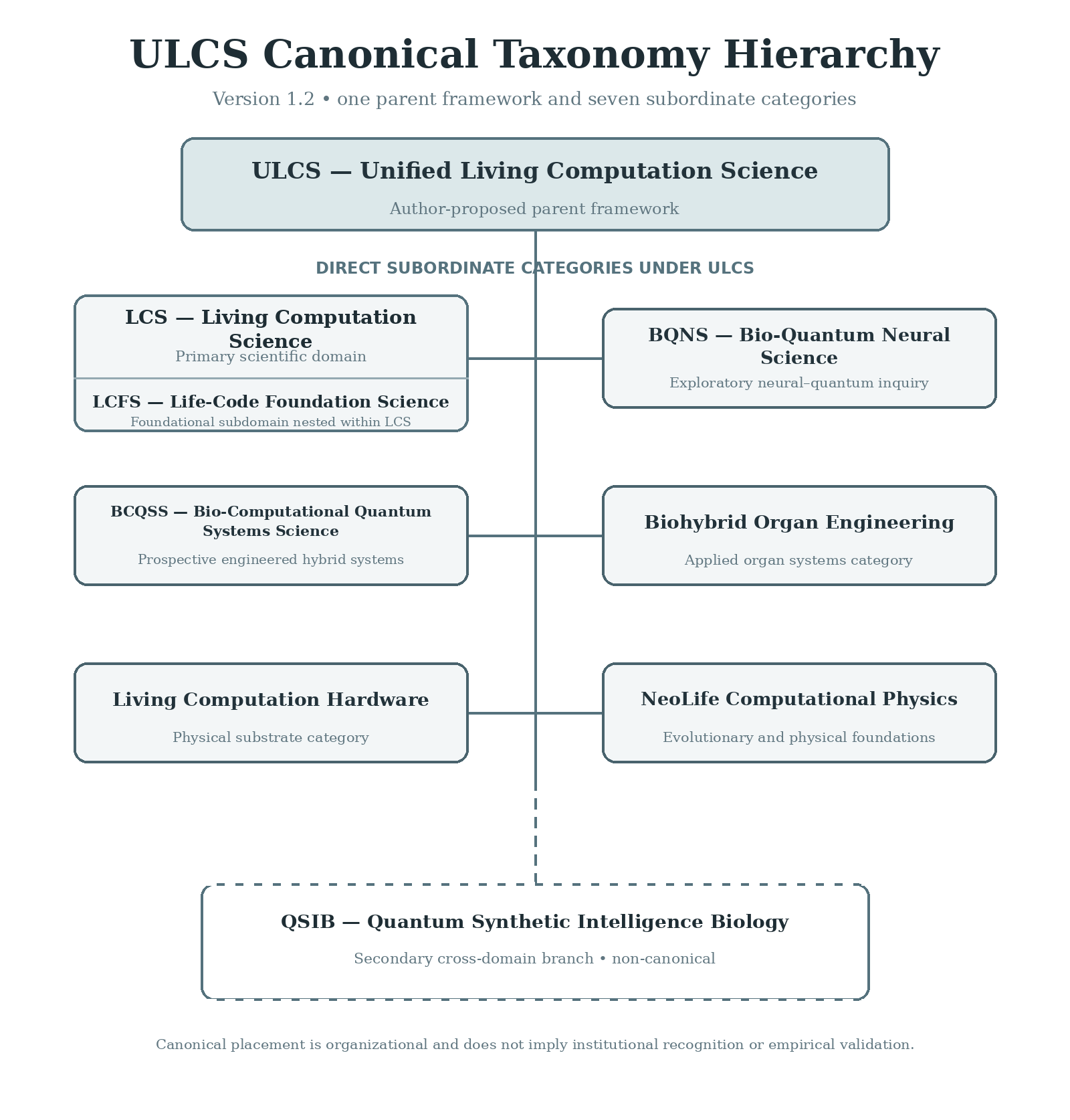
Within this author-proposed taxonomy, ULCS is the parent framework or “megadiscipline.”
LCS operates as a primary scientific domain under ULCS.
LCFS is a specialized foundational subdomain within LCS.
All remaining canonical categories interoperate within the ULCS framework without replacing or superseding one another.
15
16. The ULCS Canonical Taxonomy
The ULCS Canonical Taxonomy defines eight coordinated categories—one parent framework and seven subordinate categories—that collectively describe the principal structural areas of inquiry within Unified Living Computation Science.
Eight Canonical Categories of Unified Living Computation Science
- Unified Living Computation Science (ULCS) — Parent Megadiscipline
- Living Computation Science (LCS) — Intrinsic biological computation
- Life-Code Foundation Science (LCFS) — Executable biological information
- Bio-Quantum Neural Science (BQNS) — Quantum-adjacent neural phenomena
- Bio-Computational Quantum Systems Science (BCQSS) — Engineered hybrid systems
- Biohybrid Organ Engineering — Organ-level biological–synthetic integration
- Living Computation Hardware — Physical computational substrates
- NeoLife Computational Physics — Emergent computational grounding in physics
This document establishes:
- Canonical structural definitions
- Cross-disciplinary compatibility
- Explicit governance and version control
- Non-replacement boundaries
- Long-term taxonomic stability
ULCS is classificatory. It does not assert ownership over biology, physics, technology, scientific ideas, or discovery.
Its purpose is structural coherence across disciplines increasingly converging around computation in living systems.
Version 1.2 constitutes the fixed Foundational Canonical Taxonomy of Unified Living Computation Science (ULCS). This Revised Scholarly Edition, dated July 18, 2026, preserves the eight-category hierarchy while correcting the presentation sequence, documenting the taxonomy-development method, clarifying evidence status and limitations, and expanding scholarly citations. Future publications may expand research applications or educational materials without altering the canonical taxonomy defined in this edition.
16.1. The Eight Canonical ULCS Categories
ULCS organizes computational phenomena occurring in living, synthetic, and hybrid systems through a structured taxonomy consisting of one parent megadiscipline and seven subordinate scientific categories. Together, these eight canonical categories define the scope, hierarchy, and organizational structure of Unified Living Computation Science Version 1.2.
I. ULCS — Unified Living Computation Science
Parent Megadiscipline
The top-level author-defined container that organizes subordinate categories concerned with computation in living, synthetic, and hybrid systems.
II. LCS — Living Computation Science
Core Domain
The study of how living systems compute, process information, and regulate behavior at cellular, organismal, collective, and ecological scales.
III. LCFS — Life-Code Foundation Science
Foundational Subdomain of LCS
Biology formalized as executable, generative, and interpretable code, including genetic, epigenetic, metabolic, and developmental programs.
IV. BQNS — Bio-Quantum Neural Science
Neural–Quantum Domain
An exploratory category for testable hypotheses about whether specified quantum, coherent, or other non-classical effects could contribute to biological neural computation.
V. BCQSS — Bio-Computational Quantum Systems Science
Engineered Systems Domain
Prospective classification of engineered-system concepts combining biological substrates with quantum-adjacent principles; no operational bio-quantum computer is presumed.
VI. Biohybrid Organ Engineering
Applied Organ Systems Domain
Classification of research on organs and organ-like systems that combine biological and engineered components for sensing, regulation, adaptation, or identifiable information processing.
VII. Living Computation Hardware
Physical Substrate Domain
Classification of material, chemical, biological, and hybrid substrates proposed or demonstrated to instantiate identifiable living-computation processes.
VIII. NeoLife Computational Physics
Evolutionary & Physical Foundations Domain
Research on physical constraints relevant to inheritance, evolution, adaptation, emergence, and engineered life systems across natural and artificial contexts.
16.2. Secondary Cross-Domain Branch (Non-Canonical)
QSIB — Quantum Synthetic Intelligence Biology
Quantum Synthetic Intelligence Biology (QSIB) is recognized as a secondary cross-domain research branch within the broader ULCS framework.
QSIB is not one of the eight canonical domains defined in Version 1.2. It does not alter, extend, or modify the canonical hierarchy.
QSIB operates transversally across multiple ULCS domains where synthetic intelligence systems, biological substrates, and quantum-adjacent physical principles intersect conceptually or experimentally.
Specifically, QSIB may interface with:
- Living Computation Science (LCS) — when synthetic systems are compared to intrinsic biological computation
- Life-Code Foundation Science (LCFS) — when biological code interacts with synthetic or programmable systems
- Bio-Quantum Neural Science (BQNS) — when quantum-adjacent neural phenomena are examined in relation to synthetic intelligence models
- Bio-Computational Quantum Systems Science (BCQSS) — when engineered hybrid architectures incorporate biological and quantum-informed design principles
QSIB functions as a research coordination layer rather than a canonical structural domain. It provides conceptual alignment for interdisciplinary inquiry at the boundary of synthetic intelligence, biological computation, and quantum-informed modeling.
QSIB does not:
- Constitute a separate megadiscipline
- Modify the ULCS canonical hierarchy
- Supersede any of the eight canonical domains
- Assert technological feasibility or implementation
Its recognition within this document is descriptive and organizational only.
The ULCS Canonical Hierarchy defined in Version 1.2 remains unchanged.
16.3. Category Boundaries & Non-Overlap Principle
The eight canonical categories defined in Version 1.2 are structurally differentiated and hierarchically coordinated.
Each subordinate category represents a classification layer within ULCS and is defined primarily by scope, substrate, scale, or research function rather than by institutional jurisdiction.
No canonical domain shall be interpreted as:
- Replacing existing scientific disciplines
- Claiming exclusive jurisdiction over biological or physical phenomena
- Overriding institutional authority in research, engineering, or medicine
- Redefining established academic fields
Overlap with existing disciplines indicates structural alignment, not domain absorption.
Where interdisciplinary convergence occurs, ULCS provides taxonomic coordination rather than disciplinary consolidation.
16–21
17. ULCS — Detailed Canonical Index
Category Definitions & Sub‑Domain Structure
This section expands the Canonical Index into a secondary detailed index. It remains classificatory, non‑inventive, and structurally descriptive. This section provides expanded domain definitions and internal structural organization for the ULCS framework.
17.1. ULCS — Unified Living Computation Science
Parent Megadiscipline
Unified Living Computation Science (ULCS) is the top-level author-proposed framework for classifying and organizing research on computation in living, synthetic, and hybrid systems.
ULCS maps proposed relationships among biological computation, physical substrates, carefully specified quantumadjacent hypotheses, engineered life systems, and emergent intelligence. It does not replace existing sciences; it offers a common classificatory lens.
Primary Scope
- Living systems as computational entities
- Hybrid biological–synthetic computation
- Cross‑scale organization (molecular → ecological)
- Integration of physics, biology, and computation
Canonical Sub‑Domains
The taxonomy comprises ULCS as the parent framework and seven subordinate categories. LCS is the primary scientific domain, LCFS is nested within LCS, and the remaining five categories operate laterally under ULCS. The subordinate categories are coordinated components of the framework rather than peers to the parent framework.
- Unified Living Computation Science (ULCS)
- Living Computation Science (LCS)
- Life‑Code Foundation Science (LCFS)
- Bio‑Quantum Neural Science (BQNS)
- Bio‑Computational Quantum Systems Science (BCQSS)
- Biohybrid Organ Engineering
- Living Computation Hardware
- NeoLife Computational Physics
17.1.1. Formal Definition
Unified Living Computation Science (ULCS) is an author-proposed scientific megadiscipline concerned with the systematic classification and organization of computation as it occurs in living, synthetic, and hybrid systems.
ULCS examines cases in which living or biohybrid systems can be described through identifiable informationprocessing or state-transformation accounts constrained by physical law and biological organization.
17.1.2. Purpose and Role of ULCS
ULCS is proposed to coordinate terminology and relationships across established fields that independently study biological computation, artificial intelligence, quantum biology, synthetic biology, and engineered organisms.
The role of ULCS is not to replace existing sciences, but to:
- Provide a shared computational language
- Establish cross-domain compatibility
- Enable comparative analysis across scales and substrates
17.1.3. ULCS as a Proposed Fifth Scientific Megadiscipline
ULCS is proposed as a fifth scientific megadiscipline alongside Physics, Chemistry, Biology, and Computer Science.
This designation is conceptual and organizational rather than institutional, and does not assert formal academic recognition or jurisdiction.
It complements these sciences by focusing specifically on computation as a property of living and life-adjacent systems, rather than on matter, energy, molecules, or abstract algorithms alone.
17.1.4. Scope of the Framework
ULCS organizes structural classification and conceptual coordination only. It does not claim experimental authority, disciplinary jurisdiction, or priority over discoveries made within established fields.
The author-maintained scope of ULCS is limited to:
- Taxonomy
- Conceptual unification
- Cross-domain mapping
- Systems level interpretation
17.1.5. Canonical Categories Organized by ULCS
The Version 1.2 taxonomy comprises the following eight canonical categories:
- Unified Living Computation Science (ULCS)
- Living Computation Science (LCS)
- Life-Code Foundation Science (LCFS)
- Bio-Quantum Neural Science (BQNS)
- Bio-Computational Quantum Systems Science (BCQSS)
- Biohybrid Organ Engineering
- Living Computation Hardware
- NeoLife Computational Physics
These domains are internally coordinated and structurally interoperable within the ULCS framework.
17.1.6. Structural Hierarchy
ULCS establishes the following hierarchy:
ULCS
→ LCS
→ LCFS
All other canonical domains interface laterally within ULCS without hierarchical subordination unless explicitly defined.
17.1.7. Boundaries and Exclusions
ULCS explicitly does not:
- Claim ownership of biological systems
- Redefine existing scientific laws
- Assert experimental primacy
- Override established disciplines
- ULCS is classificatory, not extractive.
17.1.8. Relationship to Technology and Engineering
ULCS provides a conceptual framework within which technologies may be classified, compared, and contextualized.
Technological implementations are examples, not constituents, of ULCS.
17.1.9. Canonical Stability Clause
The definition and scope of ULCS are fixed for Version 1.2.
Any expansion, revision, or reinterpretation must be published as a subsequent version and does not retroactively modify this canonical section.
22–24
17.2. LCS — Living Computation Science
Core Scientific Domain
Living Computation Science (LCS) studies how living systems process information, make decisions, regulate internal states, and adapt across time.
LCS focuses on computation that is intrinsic to life itself, independent of engineered hardware.
Primary Scope
- Cellular signaling as computation
- Organism‑level control systems
- Collective and swarm intelligence
- Ecological information dynamics
Canonical Sub‑Domains
- Life‑Code Foundation Science (LCFS)
- Developmental computation
- Metabolic and regulatory networks
- Adaptive and learning biological systems
17.2.1. Formal Definition
Living Computation Science (LCS) is the scientific domain concerned with how living systems process information, perform computation, regulate internal states, and adapt behavior across time.
LCS treats life itself as a computational process, independent of engineered hardware or artificial substrates.
17.2.2. Scope of Living Computation
LCS studies computation as it naturally occurs within:
- Cells and molecular networks
- Tissues and organs
- Whole organisms
- Collectives, swarms, and ecosystems
17.2.3. Core Computational Mechanisms
Living computation within LCS includes, but is not limited to:
- Signal transduction and regulatory logic
- Feedback and control loops
- Learning and adaptation
- Memory encoded in biological state
17.2.4. Relationship to ULCS
LCS operates as a primary domain under ULCS.
ULCS provides the overarching classification framework, while LCS provides the core scientific substance describing intrinsic biological computation.
17.2.5. Relationship to LCFS
Life-Code Foundation Science (LCFS) is a foundational subdomain of LCS.
LCFS specializes in the formalization of biological computation as executable and generative code. LCS remains broader, encompassing non-genetic and non-code-based living computation.
17.2.6. Canonical Sub-Domains of LCS
LCS canonically includes the following sub-domains:
- Life-Code Foundation Science (LCFS)
- Developmental computation
- Metabolic and regulatory networks
- Adaptive and learning biological systems
- Collective and swarm computation
- Ecological information dynamics
17.2.7. Boundaries and Exclusions
LCS does not:
- Claim engineered artificial intelligence systems
- Replace neuroscience, biology, or ecology
- Require quantum effects for validity
LCS is concerned with natural, intrinsic computation in living systems.
17.2.8. Relationship to Technology
Technologies may be inspired by or modeled after principles studied in LCS, but they are not constituents of LCS itself.
LCS remains a scientific domain, not an engineering discipline.
17.2.9. Canonical Stability Clause
The definition and scope of LCS are fixed for Version 1.2.
Any modification must be introduced as a subsequent version and does not retroactively alter this section.
25–26
17.3. LCFS — Life‑Code Foundation Science
Foundational Subdomain of LCS
Life‑Code Foundation Science (LCFS) formalizes biology as executable, generative code. It treats genetic, epigenetic, and biochemical systems as programmable information structures.
LCFS provides the foundational layer for understanding how biological computation is written, modified, and executed.
Primary Scope
- Genetic and epigenetic code systems
- Regulatory logic and control architecture
- Developmental and morphogenetic programs
Canonical Sub‑Domains
- Genetic code systems
- Epigenetic control layers
- Developmental instruction sets
- Metabolic logic architectures
17.3.1. Formal Definition
Life-Code Foundation Science (LCFS) is the proposed subdomain concerned with modeling, classifying, and interpreting biological regulatory systems as structured, executable, and generative information. This framing is informed by established work in systems and synthetic biology but is not intended to reduce all biological causation to digital code (Endy, 2005; Alon, 2006; Gao et al., 2018).
LCFS treats genetic, epigenetic, metabolic, and developmental processes as information-bearing programs that can be analyzed without asserting inventorship or ownership over biology.
17.3.2. Position Within ULCS and LCS
LCFS operates as a foundational subdomain of LCS under the ULCS framework.
LCS describes intrinsic living computation broadly. LCFS specializes this scope by focusing on the informational encoding and execution layers of life.
17.3.3. Scope of Life-Code
LCFS encompasses biological code expressed through the following systems:
- Genetic sequences and regulatory elements
- Epigenetic markers and chromatin states
- Metabolic pathways and signaling cascades
- Developmental instruction sets
17.3.4. Executable and Generative Properties
Life-code within LCFS is characterized by:
- Executability (biological processes enact instructions)
- Generativity (complex structures emerge from compact code)
- Modularity (code segments interact and recombine)
- Context-dependence (execution varies by environment and state)
17.3.5. Canonical Sub-Domains of LCFS
LCFS canonically includes:
- Genetic code systems
- Epigenetic control layers
- Developmental programming frameworks
- Metabolic logic architectures
- Regulatory network dynamics
17.3.6. Relationship to BQNS and BCQSS
LCFS does not require quantum effects for validity.
BQNS and BCQSS may interface with LCFS when biological code interacts with quantum or engineered systems, but LCFS remains a classical biological information framework.
17.3.7. Boundaries and Exclusions
LCFS does not:
- Claim gene-editing techniques
- Assert ownership of genetic material
- Replace molecular biology or genetics
LCFS is classificatory and interpretive.
17.3.8. Relationship to Technology
Technologies that read, write, or simulate biological code may be classified relative to LCFS, but they are not constituents of the domain itself.
17.3.9. Canonical Stability Clause
The definition and scope of LCFS are fixed for Version 1.2.
Any expansion or modification must be introduced as a subsequent version.
27–28
17.4. BQNS — Bio‑Quantum Neural Science
Neural–Quantum Domain
Bio-Quantum Neural Science (BQNS) organizes testable hypotheses concerning quantum, coherent, or other nonclassical phenomena that might participate in biological neural systems.
BQNS focuses on whether specified quantum-level effects could make empirically distinguishable contributions to neural computation; it does not presume effects on cognition, perception, memory, or consciousness.
Primary Scope
- Quantum coherence in neural tissue
- Non‑classical signaling mechanisms
- Neural phase synchronization
Canonical Sub‑Domains
- Quantum neural coherence models
- Bio‑photonic neural signaling
- Quantum‑influenced cognition frameworks
17.4.1. Formal Definition
Bio‑Quantum Neural Science (BQNS) is the proposed exploratory domain concerned with investigating whether and how quantum-level, coherent, or other non-classical physical processes could participate in neural function. The category organizes testable hypotheses; it does not assert that quantum mechanisms of cognition, perception, memory, or consciousness have been established (Tegmark, 2000; Lambert et al., 2013; Cao et al., 2020).
BQNS is exploratory and explanatory in nature. It does not assert universal quantum necessity for neural function.
17.4.2. Position Within ULCS
BQNS operates as a specialized canonical domain under ULCS.
It interfaces with Living Computation Science (LCS) and Life-Code Foundation Science (LCFS) when a specified quantum-adjacent hypothesis makes predictions that can be distinguished from classical biological or computational explanations.
17.4.3. Scope of Inquiry
BQNS investigates candidate phenomena including:
- Quantum coherence in neural substrates
- Non‑classical signaling or energy transfer
- Phase synchronization and resonance effects
- Quantum‑influenced sensory or cognitive processes
17.4.4. Distinction From Classical Neuroscience
BQNS does not replace neuroscience, neurobiology, or cognitive science.
Classical neurobiological models remain the evidential default for neural phenomena. BQNS is restricted to clearly specified, testable cases in which a proposed quantum mechanism offers an empirically distinguishable explanation; speculative invocation of quantum terminology alone is insufficient (Tegmark, 2000; Cao et al., 2020).
17.4.5. Canonical Sub‑Domains of BQNS
BQNS canonically includes:
- Neural quantum coherence models
- Bio‑photonic neural signaling frameworks
- Phase‑based neural synchronization studies
- Quantum‑adjacent cognitive models
17.4.6. Relationship to LCFS and LCS
BQNS does not redefine biological code or intrinsic living computation.
LCFS organizes biological information encoding, LCS organizes intrinsic living computation, and BQNS organizes candidate physical mechanisms that could be tested for a role in these processes.
17.4.7. Boundaries and Exclusions
BQNS does not:
- Claim proof of quantum consciousness
- Assert quantum supremacy of the brain
- Replace established neural science
- Claim technological realization
BQNS remains a scientific classification and research framing domain.
17.4.8. Relationship to Technology
Technologies inspired by quantum‑biological hypotheses may be classified relative to BQNS, but BQNS itself is not a technology domain.
17.4.9. Canonical Stability Clause
The definition and scope of BQNS are fixed for Version 1.2.
Future refinements must be introduced as subsequent versions without retroactive effect.
29–30
17.5. BCQSS — Bio‑Computational Quantum Systems Science
Engineered Systems Domain
BCQSS organizes proposed designs and analyses for engineered systems that combine biological substrates with quantum-adjacent or quantum-computational principles.
This author-proposed domain is prospective and does not assume that operational bio-quantum computers exist.
Primary Scope
- Hybrid bio‑quantum architectures
- Coherence‑preserving biological systems
- Controlled quantum‑biological interfaces
Canonical Sub‑Domains
- Bio‑quantum hardware architectures
- Hybrid control systems
- Quantum‑biological integration frameworks
BCQSS functions as a bridging domain between LCFS (biological information modeling) and BQNS (quantumbiological phenomena), while remaining conservative and non-claiming in scope.
17.5.1. Formal Definition
Bio-Computational Quantum Systems Science (BCQSS) is an author-proposed classificatory domain for analyzing engineered-system concepts that integrate biological substrates, computational architectures, and quantum-adjacent physical principles.
BCQSS does not assert the existence of operational quantum-biological computers. It classifies design frameworks, interfaces, and control architectures proposed or studied across disciplines.
17.5.2. Position Within ULCS
BCQSS operates as a canonical applied-systems domain under ULCS.
It interfaces upward with ULCS for taxonomy, laterally with Living Computation Science (LCS) and Life-Code Foundation Science (LCFS) for biological computation modeling, and conceptually with Bio-Quantum Neural Science (BQNS) for long-horizon quantum considerations.
17.5.3. Scope of Inquiry
BCQSS addresses systems characterized by:
- Biological components used as computational or control substrates
- Quantum-adjacent physical effects influencing system behavior
- Hybrid architecture combining biological, physical, and computational elements
- Engineered interfaces between living matter and non-living systems
17.5.4. Distinction From BQNS
BCQSS is engineering- and systems-oriented, whereas BQNS is exploratory and phenomenological.
- BQNS asks whether quantum phenomena may participate in biological neural computation.
- BCQSS classifies how engineered systems might be structured if such phenomena are considered.
- BCQSS does not depend on proof of BQNS hypotheses.
17.5.5. Distinction From LCFS
LCFS focuses on biological information as executable code.
BCQSS focuses on system architectures that may incorporate LCFS-modeled biological components within broader engineered systems.
17.5.6. Canonical Sub-Domains of BCQSS
BCQSS canonically includes:
- Bio-computational system architectures
- Hybrid biological–physical interfaces
- Control and feedback systems involving living substrates
- Coherence-aware system modeling (conceptual)
- Bio-integrated sensing and actuation frameworks
17.5.7. Boundaries and Exclusions
BCQSS does not:
- Claim functional quantum-biological computers
- Assert feasibility of living qubits
- Replace quantum computing or bioengineering disciplines
- BCQSS remains classificatory and architectural.
17.5.8. Relationship to Technology
Technologies may be classified relative to BCQSS when they involve hybrid biological and physical system design. BCQSS itself does not constitute a technology claim.
17.5.9. Canonical Stability Clause
The definition and scope of BCQSS are fixed for Version 1.2.
Any future elaboration must be published as a subsequent version without retroactive effect.
31–32
17.6. Biohybrid Organ Engineering
Applied Organ Systems Domain
Biohybrid Organ Engineering organizes research and design concepts involving organs and organ-like systems that sense, regulate, adapt, or perform identifiable information-processing functions while interacting with biological or engineered environments.
Primary Scope
- Computational organs
- Sensory and adaptive biohybrid systems
- Organ‑level integration architectures
Canonical Sub‑Domains
- Synthetic sensory organs
- Adaptive organ control systems
- Biohybrid integration platforms
Biohybrid Organ Engineering functions as an applied domain bridging LCS (intrinsic living computation at the organ level), LCFS (biological code governing development and function), and BCQSS (engineered system architectures involving living substrates), while remaining classificatory and non-claiming in scope.
17.6.1. Formal Definition
Biohybrid Organ Engineering is an author-proposed classificatory domain for research on organs and organ-like systems that combine biological tissue with synthetic, computational, or engineered components.
This domain focuses on organs that sense, process information, adapt, and interact dynamically with their biological and physical environments.
17.6.2. Position Within ULCS
Biohybrid Organ Engineering operates as an applied canonical domain under ULCS.
It interfaces with:
Living Computation Science (LCS) — intrinsic biological computation at the organ level Life-Code Foundation Science (LCFS) — biological code governing development and function Bio-Computational Quantum Systems Science (BCQSS) — engineered system architectures involving living substrates
This domain is applied and construct‑oriented, while remaining classificatory.
17.6.3. Scope of the Domain
Biohybrid Organ Engineering addresses systems characterized by:
Living tissue integrated with engineered materials
Organ‑level computation, sensing, and control
Adaptive and self‑regulating biological functions
Interfaces between organs and synthetic systems
17.6.4. Types of Biohybrid Organs
This domain includes, but is not limited to:
Sensory organs augmented or constructed with synthetic components
Computational or decision‑support organs
Adaptive regulatory organs
Therapeutic and restorative biohybrid organs
17.6.5. Distinction From Related Domains
Biohybrid Organ Engineering:
Is not traditional biomedical device engineering
Is not purely synthetic organ fabrication
Does not claim replacement of natural organs
It focuses on hybrid biological–engineered organ systems as a distinct class.
17.6.6. Canonical Sub‑Domains
Biohybrid Organ Engineering canonically includes:
Synthetic sensory organ systems
Computational organ architectures
Adaptive biohybrid control organs
Organ‑level biological–synthetic interfaces
Integrated organ communication systems
17.6.7. Boundaries and Exclusions
This domain does not:
Claim clinical readiness or deployment
Assert inventorship over biological organs
Replace medicine, surgery, or biotechnology
It remains classificatory and organizational.
17.6.8. Relationship to Technology
Technologies may be classified within this domain when they involve hybrid organ‑level biological and engineered integration.
The domain itself does not constitute a product or medical claim.
17.6.9. Canonical Stability Clause
The definition and scope of Biohybrid Organ Engineering are fixed for Version 1.2.
Any future expansion must be introduced as a subsequent version without retroactive effect.
33–34
17.7. Living Computation Hardware
Physical Substrate Domain
Living Computation Hardware organizes physical materials and substrates proposed or demonstrated to instantiate living computation, including biological, chemical, and hybrid systems.
Primary Scope
- Biological computing substrates
- Hybrid material systems
- Energy‑information coupling in matter
Canonical Sub‑Domains
- Biological hardware substrates
- Hybrid living‑synthetic materials
- Computation‑embedded matter systems
Living Computation Hardware functions as a substrate-focused domain bridging LCS (intrinsic living computation), LCFS (biological information execution), Biohybrid Organ Engineering (organ-level systems), and BCQSS (engineered hybrid architectures), while remaining classificatory and non-claiming in scope.
17.7.1. Formal Definition
Living Computation Hardware is an author-proposed classificatory domain for physical substrates—biological, chemical, material, or hybrid—that realize an identifiable computational process in living or life-adjacent systems.
17.7.2. Position Within ULCS
Living Computation Hardware operates as a foundational physical-domain layer under ULCS.
It interfaces with:
LCS for intrinsic biological computation
LCFS for executable biological information
Biohybrid Organ Engineering for organ-level implementations
BCQSS for engineered hybrid systems
17.7.3. Scope of the Domain
This domain addresses substrates characterized by:
Physical embodiment of information processing
Energy–information coupling in matter
Material constraints on computation
Living, semi-living, and hybrid hardware forms
17.7.4. Classes of Living Computation Hardware
Living Computation Hardware includes, but is not limited to:
Biological tissues and cellular substrates
Chemical and biochemical computing media
Hybrid living–synthetic materials
Adaptive and self-modifying material systems
17.7.5. Distinction From Conventional Hardware
Living Computation Hardware:
Is not limited to silicon-based electronics
Is not traditional digital hardware engineering
Does not require artificial intelligence systems
It focuses on non-traditional, living, and material embodiments of computation.
17.7.6. Canonical Sub-Domains
Living Computation Hardware canonically includes:
Biological computing substrates
Hybrid living–synthetic materials
Chemical and metabolic computing media
Energy-responsive computational matter
Computation-embedded material systems
17.7.7. Boundaries and Exclusions
This domain does not:
Claim superiority over electronic computing
Assert manufacturability or scalability
Replace materials science, chemistry, or electronics
It remains classificatory and organizational.
17.7.8. Relationship to Technology
Technologies may be classified within this domain when they depend on living or material substrates to physically instantiate computation.
The domain itself does not constitute a technology or product claim.
17.7.9. Canonical Stability Clause
The definition and scope of Living Computation Hardware are fixed for Version 1.2.
Any future expansion must be introduced as a subsequent version without retroactive effect.
35–36
17.8. NeoLife Computational Physics
Evolutionary & Physical Foundations Domain
NeoLife Computational Physics organizes research on physical constraints relevant to inheritance, evolution, adaptation, emergence, and engineered life systems.
Primary Scope
- Physics of evolution and inheritance
- Emergent system dynamics
- Engineered life constraints
Canonical Sub‑Domains
- Evolutionary computation physics
- Inheritance dynamics
- Emergent life system models
NeoLife Computational Physics functions as a foundational domain bridging Physics (fundamental law), LCS (living computation), LCFS (biological information execution), and Living Computation Hardware (physical substrates), while remaining classificatory and non-claiming in scope.
17.8.1. Formal Definition
NeoLife Computational Physics is an author-proposed theoretical domain for studying when and how computational descriptions of living, semi-living, and engineered life systems can be grounded in physical law.
It focuses on computation as an emergent property of matter, energy, and organization under evolutionary and thermodynamic constraints.
17.8.2. Position Within ULCS
NeoLife Computational Physics operates as a foundational theoretical domain under ULCS.
It provides physical grounding for:
LCS — intrinsic computation in living systems
LCFS — execution of biological information
Living Computation Hardware — material instantiation of computation
Biohybrid Organ Engineering — organ-level physical constraints
17.8.3. Scope of the Domain
This domain addresses phenomena including:
Energy–information relationships in living matter
Physical constraints on computation and adaptation
Emergence of organized behavior from physical systems
Evolution modeled as a computational process under physical constraints
17.8.4. Core Physical Concepts
NeoLife Computational Physics includes, but is not limited to:
Thermodynamics of living systems
Information theory applied to biological matter
Physical limits of computation in life
Self-organization and emergent dynamics
17.8.5. Distinction From Conventional Physics
NeoLife Computational Physics:
Does not replace fundamental physics
Does not redefine physical laws
Does not claim new forces or constants
It focuses on how existing physical laws manifest as computation in life and engineered systems.
17.8.6. Canonical Sub-Domains
NeoLife Computational Physics canonically includes:
Physics of biological information
Evolutionary computation dynamics
Emergent system physics
Physical limits of adaptive systems
Inheritance and constraint modeling
17.8.7. Boundaries and Exclusions
This domain does not:
- Claim experimental discovery of new physical laws
- Replace biology, physics, or information theory
- Assert technological feasibility or implementation
It remains theoretical and classificatory.
17.8.8. Relationship to Technology
Technologies may be classified relative to this domain when they depend on physical principles governing living or adaptive computation.
The domain itself does not constitute a technology or product claim.
17.8.9. Canonical Stability Clause
The definition and scope of NeoLife Computational Physics are fixed for Version 1.2.
Any future expansion must be introduced as a subsequent version without retroactive effect.
The authoritative taxonomy is defined in Sections 16 and 17. Illustrative examples, diagrams, and cross-domain mappings must be read as explanatory tools rather than additional canonical categories.
37–38
22–38
18. Canonical Interpretation and Use
Section 18 documents how the taxonomy was constructed and should be interpreted. It distinguishes authorproposed categories from established research fields, defines key terms, states limitations and responsible-research principles, and records authorship and AI assistance. Nothing in this section alters the Version 1.2 hierarchy.
18.1. Taxonomy-Development Method
ULCS was developed as a conceptual classification framework using a deductive–iterative method informed by established taxonomy-development practice. The process combined conceptual distinctions drawn from information theory, systems biology, synthetic biology, biocomputation, bioengineering, and quantum biology with repeated boundary and overlap checks. This approach is consistent with the use of conceptual-to-empirical and empirical-toconceptual cycles in taxonomy design (Nickerson et al., 2013).
Literature scope
The scholarly basis is a targeted scoping review of representative foundational and contemporary literature available through July 18, 2026. It is not presented as a systematic review, bibliometric census, or exhaustive evidence synthesis.
Classification dimensions
- Primary object of study: intrinsic living processes, biological information, neural phenomena, engineered organs, physical substrates, or underlying physical constraints.
- Computational role: sensing, state transformation, control, memory, learning, adaptation, construction, or information transfer.
- Substrate and scale: molecular, cellular, tissue, organ, organismal, collective, ecological, material, or hybrid.
- Research posture: descriptive, explanatory, theoretical, experimental, or engineering-oriented.
- Relationship to the parent framework: primary domain, nested subdomain, lateral category, or non-canonical cross-domain mapping.
Inclusion criteria
- The phenomenon includes an identifiable process of information use, state transformation, regulation, control, memory, learning, or adaptive response.
- A living, biologically derived, materially embodied, or explicitly biohybrid substrate is central to the research question.
- The proposed placement adds a useful boundary or relationship not already represented by a broader category.
- Claims can be expressed without asserting institutional jurisdiction, clinical readiness, or unverified technological capability.
Exclusion and boundary criteria
- Purely metaphorical uses of computation without a definable information-processing or state-transition account.
- Conventional software or electronic hardware lacking a material relationship to living, biological, or biohybrid systems.
- Medical, clinical, or product claims that require evidence and regulatory review outside the scope of a taxonomy.
- Quantum terminology used without a specified physical mechanism, measurable prediction, or empirically distinguishable hypothesis.
Validation status
The internal consistency and non-overlap rules have been author-reviewed, but the taxonomy has not yet undergone external expert elicitation, Delphi validation, formal inter-rater classification testing, bibliometric validation, or institutional adoption. Those activities are recommended as the next research phase.
18.2. Epistemic Status of ULCS Categories
The following status labels prevent the proposed taxonomy from being confused with established disciplinary consensus. “Proposed” describes the ULCS label or placement, not the existence or validity of the underlying research cited in support of it.
| Category | Status | Primary role | Evidence posture |
|---|---|---|---|
| ULCS | Author-proposed parent framework | Coordinates the taxonomy | Not an institutionally recognized discipline |
| LCS | Proposed umbrella-domain label | Intrinsic computation in living systems | Grounded in established adjacent research; hierarchy proposed |
| LCFS | Author-proposed nested category | Executable and generative biological information | Conceptually grounded; category boundaries proposed |
| BQNS | Author-proposed exploratory category | Testable quantum or non-classical neural hypotheses | Speculative and contested; no mechanism presumed |
| BCQSS | Author-proposed prospective category | Engineered bio-quantum system architectures | Largely conceptual or early-stage |
| Biohybrid Organ Engineering | Proposed integrative category | Biological-engineered organ systems | Adjacent research is active; ULCS grouping proposed |
| Living Computation Hardware | Author-proposed substrate category | Living, chemical, material, and hybrid computing media | Experimental precedents exist; label proposed |
| NeoLife Computational Physics | Author-proposed theoretical category | Physical constraints on computation in life | Related theory exists; category proposed |
| QSIB | Non-canonical cross-domain branch | Optional mapping across synthetic intelligence and biology | Conceptual coordination device only |
18.3. Operational Definitions and Usage Rules
Computation. A physically instantiated transformation of states or information under identifiable rules, constraints, or dynamics. The term does not by itself imply digital representation, consciousness, or deliberate agency.
Living computation. Information processing, regulation, control, memory, learning, or adaptive state transformation performed by, within, or through living systems.
Semi-living system. A laboratory or engineered construct that contains living components but lacks one or more properties normally associated with an autonomous organism. The term is descriptive and context-dependent.
Hybrid biological–synthetic system. A system in which biological components and engineered non-biological components are functionally coupled.
Life-adjacent system. A nonliving, partially biological, or engineered system included because it exhibits specified lifelike, adaptive, self-organizing, or biointegrated behavior. The term is heuristic and does not assign living status.
Life-code. An ULCS organizing term for biological information structures whose states influence production, regulation, development, maintenance, or adaptation. It is not a claim that organisms are reducible to conventional software.
Quantum-adjacent. A cautious boundary term for research questions involving a specified quantum-biological mechanism or a testable interface with quantum physical principles. It must not be used as a substitute for evidence.
Canonical. Fixed within the author-maintained Version 1.2 publication. The word does not imply universal scientific acceptance, institutional authority, or regulatory status.
Megadiscipline. An author-proposed organizational term for a framework intended to coordinate several domains. It is not presented as a formally recognized rank in an established academic classification system.
18.4. Limitations
- ULCS is a conceptual taxonomy and scholarly proposal, not an empirical experiment or demonstration of a new natural law.
- The literature review is targeted and representative rather than systematic or exhaustive.
- Several category names and boundaries are author-proposed and have not been adopted by universities, journals, professional societies, or standards bodies.
- Biological processes may satisfy more than one classification dimension; non-overlap is therefore an organizational objective rather than a claim of perfect natural separability.
- BQNS and BCQSS include speculative or emerging questions. Their inclusion organizes hypotheses and does not elevate them to established mechanisms or technologies.
- No external expert panel, inter-rater study, bibliometric test, or peer-reviewed validation of the full taxonomy has yet been completed.
- Illustrative diagrams and mappings are explanatory representations, not causal models, experimental results, or predictions of technical readiness.
18.5. Ethics, Biosafety, and Responsible Research
Research mapped by ULCS may involve neural organoids, engineered organisms, gene regulation, biohybrid devices, environmental release, or dual-use capabilities. Classification does not replace ethics review, biosafety assessment, biosecurity review, informed-consent requirements, animal- or human-subject protections, or applicable regulation. Organoid-intelligence research also raises unresolved questions concerning donor consent, moral status, welfare, and responsible communication (Smirnova et al., 2023; Hartung et al., 2024).
- Separate conceptual classification from claims of clinical efficacy, consciousness, sentience, or technological readiness.
- Use proportionate biosafety and biosecurity controls for synthetic biology and engineered living systems.
- Evaluate environmental containment, reversibility, and lifecycle risks before release or deployment.
- Document the provenance of human-derived cells and comply with consent, privacy, and oversight requirements.
- Communicate uncertainty and evidence status clearly, particularly for neural and quantum-related claims.
- Consider equitable access, disability perspectives, cultural values, and potential social consequences when proposing applications.
18.6. Interoperability and Machine-Readable Representation
A future machine-readable ULCS release should represent each category as a persistent concept with a preferred label, definition, scope note, broader/narrower relationships, related-concept links, provenance, evidence status, and version metadata. The W3C Simple Knowledge Organization System provides a standard data model for expressing taxonomies and other knowledge-organization systems, while ISO 25964 addresses interoperability among structured vocabularies (ISO, 2013; W3C, 2009).
18.7. Authorship and AI-Assistance Disclosure
Thomas Francis Doyle IV is the author and originator of the ULCS framework presented in this publication. AIassisted tools were used for editorial development, consistency checking, formatting, source discovery and organization, and diagram preparation. The author directed the work, reviewed the final manuscript, and retains responsibility for the taxonomy, source selection, interpretations, and claims. AI assistance is not listed as authorship and does not constitute independent scientific validation.
39–41
19. Illustrative Research Areas Within ULCS
ULCS classification intersects with multiple existing areas of scientific research concerned with computation in living systems and biological information processing. The purpose of this section is to provide illustrative examples of research domains that align with ULCS.
Examples of such areas include:
- Systems biology and biological network dynamics (Kitano, 2002; Alon, 2006)
- Biological information processing and cellular computation (Bray, 1995; Helikar et al., 2008; Uhlendorf et al., 2012)
- Neural computation, biological neural networks, and organoid computing (Sumi et al., 2023; Cai et al., 2023; Alam El Din et al., 2025)
- Synthetic biological circuits and engineered genetic systems (Endy, 2005; Gao et al., 2018; Bashor et al., 2019; Rizik et al., 2022)
- Biohybrid computational architectures and synthetic living systems (Blackiston et al., 2021; Hu et al., 2024; Giaveri et al., 2025)
- Quantum biology and carefully specified quantum-adjacent biological hypotheses (Tegmark, 2000; Lambert et al., 2013; Cao et al., 2020)
ULCS does not replace these fields. Instead, it provides a structural classification framework that organizes how such research domains relate to computation occurring within living systems.
42
20. Institutional Positioning
Unified Living Computation Science (ULCS) is presented as a proposed scientific framework for organizing research at the intersection of computation, biology, and physical systems.
ULCS provides a structural classification framework designed to help organize and coordinate research occurring across biology, physics, computer science, bioengineering, systems science, and related fields where computational phenomena arise in living or biologically integrated systems.
ULCS may be considered for:
- Interdisciplinary research coordination
- Academic program development
- Systems-level curriculum design
- Cross-domain scientific dialogue
- Long-term taxonomic organization of convergent research areas
ULCS functions as a conceptual and structural framework and does not claim regulatory authority, jurisdictional control, funding allocation authority, or institutional governance power. Any institutional adoption, modification, or integration of ULCS would remain subject to standard academic peer review, disciplinary standards, and existing governance processes.
ULCS is proposed as a classification architecture intended to clarify and organize the emerging convergence of computation, biology, and physical systems research.
42
21. Future Development of the ULCS Framework
ULCS is intended to function as a stable classificatory framework for organizing computation as it manifests across living, semi-living, and engineered biological systems. While the canonical domain structure defined in Version 1.2 establishes the foundational taxonomy, future scientific developments may expand the framework through the identification of new interdisciplinary research areas, emerging hybrid computational systems, or newly recognized forms of biological information processing.
Such developments may be incorporated through future revisions while preserving the stability of the canonical structure established in this document. The goal of ULCS is to provide long-term structural coherence across scientific domains as research into living computation continues to evolve.
43
22. Master Canonical Disclaimer
Unified Living Computation Science (ULCS) is an author-proposed scholarly classification and organizational framework for analyzing and coordinating research on computation in living, semi-living, synthetic, and hybrid systems. It is not an institutionally recognized discipline, scientific consensus, standard, or regulatory classification.
ULCS does not assert inventorship, ownership, or priority over biological organisms, physical laws, scientific discoveries, medical procedures, engineering implementations, or technological systems.
The terms “canonical” and “authoritative” refer only to the internal, author-maintained organization of this publication. They do not confer authority over external research, disciplines, institutions, standards, or regulatory systems.
ULCS is theoretical and classificatory in nature. It does not constitute a claim of experimental discovery, clinical application, technological readiness, or exclusive scientific jurisdiction.
References to existing sciences, technologies, and biological systems are included for classification, comparison, and scholarly context. They do not imply endorsement of ULCS by the cited authors or institutions.
43
23. References
The following representative sources support the scientific context, taxonomy method, and evidence-status distinctions used in this publication. The literature cut-off for this edition is July 18, 2026. Inclusion of a source does not imply that its authors endorse ULCS.
Alam El Din, D.-M., Moenkemoeller, L., Loeffler, A., et al. (2025). Human neural organoid microphysiological systems show the building blocks necessary for basic learning and memory. Communications Biology, 8, 1237. https://doi.org/10.1038/s42003-025-08632-5
Alon, U. (2006). An introduction to systems biology: Design principles of biological circuits. Chapman & Hall/CRC.
Andersson-Rolf, A., & Clevers, H. (2026). New developments and applications of human organoids. Nature Reviews Molecular Cell Biology, 27, 543–558. https://doi.org/10.1038/s41580-026-00974-0
Baluška, F., & Levin, M. (2016). On having no head: Cognition throughout biological systems. Frontiers in Psychology, 7, 902. https://doi.org/10.3389/fpsyg.2016.00902
Bashor, C. J., Patel, N., Choubey, S., et al. (2019). Complex signal processing in synthetic gene circuits using cooperative regulatory assemblies. Science, 364(6440), 593–597. https://doi.org/10.1126/science.aau8287
Blackiston, D., Lederer, E., Kriegman, S., Garnier, S., Bongard, J., & Levin, M. (2021). A cellular platform for the development of synthetic living machines. Science Robotics, 6(52), eabf1571. https://doi.org/10.1126/scirobotics.abf1571
Bray, D. (1995). Protein molecules as computational elements in living cells. Nature, 376, 307–312. https://doi.org/10.1038/376307a0
Brooks, S. M., & Alper, H. S. (2021). Applications, challenges, and needs for employing synthetic biology beyond the lab. Nature Communications, 12, 1390. https://doi.org/10.1038/s41467-021-21740-0
Cai, H., Ao, Z., Tian, C., et al. (2023). Brain organoid reservoir computing for artificial intelligence. Nature Electronics, 6, 1032–
Cao, J., Cogdell, R. J., Coker, D. F., et al. (2020). Quantum biology revisited. Science Advances, 6(14), eaaz4888. https://doi.org/10.1126/sciadv.aaz4888
Ellison, D., Mugler, A., Brennan, M. D., et al. (2016). Cell–cell communication enhances the capacity of cell ensembles to sense shallow gradients during morphogenesis. Proceedings of the National Academy of Sciences, 113(6), E679–E688. https://doi.org/10.1073/pnas.1516503113
Endy, D. (2005). Foundations for engineering biology. Nature, 438, 449–453. https://doi.org/10.1038/nature04342
Gao, X. J., Chong, L. S., Kim, M. S., & Elowitz, M. B. (2018). Programmable protein circuits in living cells. Science, 361(6408), 1252–1258. https://doi.org/10.1126/science.aat5062
Giaveri, S., et al. (2025). Building a synthetic cell together. Nature Communications, 16, 7488. https://doi.org/10.1038/s41467025-62778-8
Hartung, T., et al. (2024). Brain organoids and organoid intelligence from ethical, legal, and social points of view. Frontiers in Artificial Intelligence, 6, 1307613. https://doi.org/10.3389/frai.2023.1307613
Helikar, T., Konvalina, J., Heidel, J., & Rogers, J. A. (2008). Emergent decision-making in biological signal transduction networks. Proceedings of the National Academy of Sciences, 105(6), 1913–1918. https://doi.org/10.1073/pnas.0705088105
Hu, N., et al. (2024). Constructing organoid-brain-computer interfaces for neurofunctional repair after brain injury. Nature Communications, 15, 9580. https://doi.org/10.1038/s41467-024-53858-2
International Organization for Standardization. (2013). ISO 25964-2:2013: Information and documentation—Thesauri and interoperability with other vocabularies—Part 2. ISO.
Kitano, H. (2002). Systems biology: A brief overview. Science, 295(5560), 1662–1664. https://doi.org/10.1126/science.1069492
Lambert, N., Chen, Y.-N., Cheng, Y.-C., Li, C.-M., Chen, G.-Y., & Nori, F. (2013). Quantum biology. Nature Physics, 9(1), 10–
Manicka, S., & Levin, M. (2019). The cognitive lens: A primer on conceptual tools for analysing information processing in developmental and regenerative morphogenesis. Philosophical Transactions of the Royal Society B, 374, 20180369. https://doi.org/10.1098/rstb.2018.0369
Nickerson, R. C., Varshney, U., & Muntermann, J. (2013). A method for taxonomy development and its application in information systems. European Journal of Information Systems, 22(3), 336–359. https://doi.org/10.1057/ejis.2012.26
Noble, D. (2006). The music of life: Biology beyond the genome. Oxford University Press.
Noble, D. (2012). A theory of biological relativity: No privileged level of causation. Interface Focus, 2(1), 55–64. https://doi.org/10.1098/rsfs.2011.0067
Pretorius, I. S., et al. (2025). The coming wave of confluent biosynthetic, bioinformational and bioengineering technologies. Nature Communications, 16, 2959. https://doi.org/10.1038/s41467-025-58030-y
Prigogine, I., & Stengers, I. (1984). Order out of chaos: Man’s new dialogue with nature. Bantam Books.
Rizik, L., Danial, L., Habib, M., Weiss, R., & Daniel, R. (2022). Synthetic neuromorphic computing in living cells. Nature Communications, 13, 5602. https://doi.org/10.1038/s41467-022-33288-8
Shannon, C. E. (1948). A mathematical theory of communication. Bell System Technical Journal, 27, 379–423, 623–656.
Shapiro, J. A. (2011). Evolution: A view from the 21st century. FT Press Science.
Sharf, T., et al. (2022). Functional neuronal circuitry and oscillatory dynamics in human brain organoids. Nature Communications, 13, 4403. https://doi.org/10.1038/s41467-022-32115-4
Smirnova, L., Caffo, B. S., Gracias, D. H., et al. (2023). Organoid intelligence: The new frontier in biocomputing and intelligence-in-a-dish. Frontiers in Science, 1, 1017235. https://doi.org/10.3389/fsci.2023.1017235
Sumi, T., et al. (2023). Biological neurons act as generalization filters in reservoir computing. Proceedings of the National Academy of Sciences, 120(25), e2217008120. https://doi.org/10.1073/pnas.2217008120
Tegmark, M. (2000). Importance of quantum decoherence in brain processes. Physical Review E, 61, 4194–4206. https://doi.org/10.1103/PhysRevE.61.4194
Turing, A. M. (1952). The chemical basis of morphogenesis. Philosophical Transactions of the Royal Society B, 237(641), 37–72. https://doi.org/10.1098/rstb.1952.0012
Uhlendorf, J., Miermont, A., Delaveau, T., et al. (2012). Long-term model predictive control of gene expression at the population and single-cell levels. Proceedings of the National Academy of Sciences, 109(35), 14271–14276. https://doi.org/10.1073/pnas.1206810109
Vanchurin, V., Wolf, Y. I., Koonin, E. V., & Katsnelson, M. I. (2022). Toward a theory of evolution as multilevel learning. Proceedings of the National Academy of Sciences, 119(6), e2120037119. https://doi.org/10.1073/pnas.2120037119
von Neumann, J. (1966). Theory of self-reproducing automata (A. W. Burks, Ed.). University of Illinois Press.
World Wide Web Consortium. (2009). SKOS Simple Knowledge Organization System reference. https://www.w3.org/TR/skos-reference/
© 2026 Thomas Francis Doyle IV All rights reserved. Copyright protection is asserted only in the original expression and in the author’s selection, coordination, and arrangement of this compilation; underlying facts, ideas, scientific principles, discoveries, and methods are not claimed.
44–46